SWIFT Payments
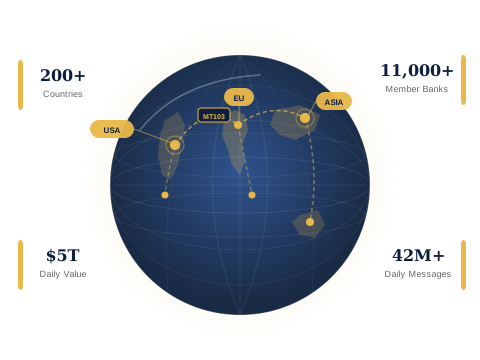
The backbone of international finance — how 11,000+ banks in 200+ countries move $5 trillion every single day through one secure messaging network.
What Is SWIFT — and What It Is Not
SWIFT — the Society for Worldwide Interbank Financial Telecommunication — is a financial messaging cooperative headquartered in La Hulpe, Belgium. It is the secure global network that banks use to send each other payment instructions.
SWIFT only sends payment instructions (messages) between banks. The actual movement of funds happens through correspondent banking relationships and settlement systems like Fedwire (USA), CHAPS (UK), TARGET2 (EU), or CLS (FX).
Think of SWIFT like a secure postal service for banks — it delivers the instruction letter, but the money moves through a separate pipeline (correspondent accounts).
Key Milestones
How a SWIFT Payment Works — End to End
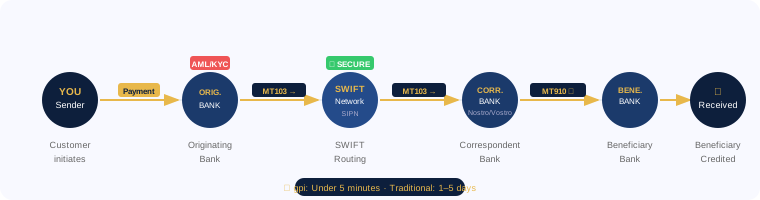
Every international wire transfer you initiate triggers a complex chain of events across multiple banks and networks. Here is exactly what happens when you send money abroad:
Initiate the Payment
Provide the beneficiary name, IBAN/account number, SWIFT/BIC code, amount, and currency via branch or internet banking. Your bank performs identity verification and rate confirmation.
AML / KYC & Message Formatting
Your bank debits your account, applies exchange rate, performs AML screening, and formats an MT103 SWIFT message containing all payment details. The message is digitally signed using PKI (Public Key Infrastructure).
Secure Routing
The MT103 enters the SWIFT Secure IP Network (SIPN). SWIFT validates the message format, authenticates both sender and receiver using digital certificates, and routes it to the appropriate destination or correspondent bank.
Nostro/Vostro Settlement
If your bank and the recipient's bank don't have a direct relationship, a correspondent bank steps in. It debits your bank's Nostro account, reformats and forwards the MT103, and may send a separate MT202 COV cover payment.
Credit & Confirmation
The recipient's bank receives the MT103, verifies the beneficiary's account, performs its own sanctions screening, and credits the beneficiary. It then sends an MT910 (Confirmation of Credit) back to the originating bank.
Net Settlement via RTGS
The actual inter-bank money movement happens through Real-Time Gross Settlement systems (Fedwire, TARGET2, CHAPS, RBI-RTGS) that settle the correspondent bank obligations irrevocably and finally.
SWIFT Code / BIC Code — Structure & How to Read It
Every bank on the SWIFT network has a unique identifier called a BIC (Bank Identifier Code) or SWIFT code, standardised under ISO 9362. You need this code to send or receive any international wire transfer.
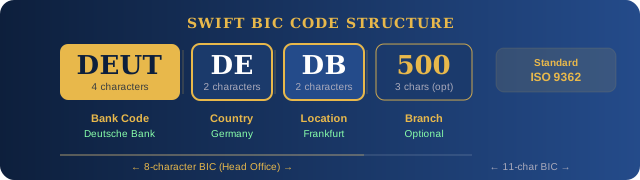
Abbreviation of the institution name. Each bank has a globally unique 4-letter code.
Standard ISO country code. IN = India, US = United States, GB = United Kingdom.
Identifies the city or primary office. Last char "1" = passive/test BIC.
Specific branch identifier. Omitted = 8-char BIC for head office. XXX = primary office.
SBININBBState Bank of IndiaICICINBBICICI BankHDFCINBBHDFC BankAXISBBINAxis BankPUNBINBBPunjab National BankKOTAK INBKotak Mahindra BankMajor Global Bank SWIFT Codes
| Bank | Country | SWIFT BIC | Hub |
|---|---|---|---|
| JPMorgan Chase | USA | CHASUS33 |
New York |
| Bank of America | USA | BOFAUS3N |
Charlotte |
| Citibank | USA | CITIUS33 |
New York |
| HSBC | United Kingdom | MIDLGB22 |
London |
| Barclays | United Kingdom | BARCGB22 |
London |
| Deutsche Bank | Germany | DEUTDEDB |
Frankfurt |
| BNP Paribas | France | BNPAFRPP |
Paris |
| UBS AG | Switzerland | UBSWCHZH |
Zurich |
| Standard Chartered | United Kingdom | SCBLGB2L |
London |
| HSBC Hong Kong | Hong Kong SAR | HSBCHKHH |
Hong Kong |
SWIFT Message Types — MT & MX Format Guide
SWIFT messages are categorised by a 3-digit number (MT format) or XML schema name (MX/ISO 20022). The MT103 is the workhorse behind every international wire transfer you send.
Customer Payments
| Message | Full Name | Direction | Key Fields | Used For |
|---|---|---|---|---|
MT101 |
Request for Transfer | Customer→Bank | :20 Ref :28D Seq :50a Ordering :59 Beneficiary :32B Amt | Bulk payment initiation by corporate customers |
MT103 |
Single Customer Credit Transfer | Bank→Bank | :20 Ref :23B Bank Op :32A Date/Cur/Amt :50K Sender :57A BenefBk :59 | Primary instrument for cross-border customer payments (wire transfer) |
MT103 STP |
Straight-Through Processing | Bank→Bank | Same as MT103 with STP flag | Automated cross-border payment, no manual intervention required |
MT110 |
Advice of Cheque | Bank→Bank | :20 Ref :30 Date :59 Payee :33B Amt | Cheque advice sent to drawee bank for verification |
FI Transfers
| Message | Full Name | Direction | Key Fields | Used For |
|---|---|---|---|---|
MT200 |
Financial Institution Transfer | Bank→Bank | :20 Ref :32A Amt :53a Sender Corr :57a Beneficiary | Own account fund transfer between a bank and its correspondent |
MT202 |
General FI Transfer | Bank→Bank | :20 Ref :21 Related Ref :32A Amt :57a Beneficiary | Interbank fund movement for liquidity, FX and own-account purposes |
MT202 COV |
Cover Payment | Bank→Bank | MT202 + :50a :59 cover fields | Cover for underlying MT103 customer payment to reimburse receiver |
MT210 |
Notice to Receive | Bank→Bank | :20 Ref :32B Amt :52a Ordering Inst | Pre-notification sent to correspondent of incoming funds |
FX & Derivatives
| Message | Full Name | Direction | Key Fields | Used For |
|---|---|---|---|---|
MT300 |
FX Trade Confirmation | Bank→Bank | :30T Trade Date :30V Value Date :36 Exchange Rate | Confirmation of a foreign exchange deal between two banks |
Trade Finance
| Message | Full Name | Direction | Key Fields | Used For |
|---|---|---|---|---|
MT700 |
Documentary Credit (LC) | Bank→Bank | :20 DC Ref :31C Expiry :50 Applicant :59 Beneficiary :32B Amt | Letter of credit issuance for trade finance transactions |
Cash Management
| Message | Full Name | Direction | Key Fields | Used For |
|---|---|---|---|---|
MT900 |
Confirmation of Debit | Bank→Customer | :20 Ref :25 Account :32A Amt | Debit confirmation sent to account holder |
MT910 |
Confirmation of Credit | Bank→Customer | :20 Ref :25 Account :32A Amt :52a Ordering | Credit confirmation sent after funds received |
MT940 |
Customer Statement | Bank→Customer | :20 Ref :25 Account :28C Statement No :60 Opening Bal :61 Entries | Full account statement for reconciliation |
System Messages
| Message | Full Name | Direction | Key Fields | Used For |
|---|---|---|---|---|
MT999 |
Free Format Message | Any→Any | Free text content | Ad-hoc communication between SWIFT member institutions |
ISO 20022 Payments New Standard
| Message | Full Name | Direction | Key Fields | Used For |
|---|---|---|---|---|
pacs.008 |
FI Customer Credit Transfer (MX) | Bank→Bank | XML: CdtTrfTxInf, Cdtr, Dbtr, IntrBkSttlmAmt | Replacement for MT103 under ISO 20022 migration (MX format) |
pacs.009 |
FI Credit Transfer (MX) | Bank→Bank | XML: CdtTrfTxInf, IntrBkSttlmAmt | Replacement for MT202 under ISO 20022 migration (MX format) |
ISO 20022 Reporting New Standard
| Message | Full Name | Direction | Key Fields | Used For |
|---|---|---|---|---|
camt.053 |
Bank-to-Customer Statement (MX) | Bank→Customer | XML: Bal, Ntry, TxDtls | Replacement for MT940 statement with richer structured data |
camt.054 |
Debit/Credit Notification (MX) | Bank→Customer | XML: Ntfctn, Ntry | Replacement for MT900/MT910 debit/credit notification |
Correspondent Banking — Nostro, Vostro & Loro Accounts
When two banks don't have a direct relationship, they use a correspondent bank as intermediary. Understanding Nostro and Vostro accounts explains why international payments take the path they do.
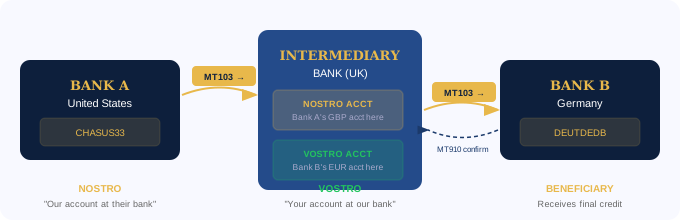
An account Bank A holds at a foreign Bank B, denominated in Bank B's currency. Used to make payments in the foreign currency without needing a branch there.
The same account from the correspondent bank's perspective. Bank B calls Bank A's account held at Bank B a Vostro — "your money deposited with us."
A third-party reference. When Bank C refers to the correspondent relationship between Bank A and Bank B, it uses the term Loro — "their account" (neither ours nor yours).
MT103 Field Map — Who Is Who in a SWIFT Payment
:50a::52a::53a::54a::57a::59a::70::71A:Charge Codes: OUR, SHA & BEN Explained
Ordering customer pays all correspondent bank charges. Beneficiary receives the exact full amount.
Sender pays originating bank fees. Beneficiary pays receiving bank fees. Intermediary charges may be deducted.
All charges are deducted from the transferred amount before crediting. Beneficiary receives less than instructed.
SWIFT gpi — Global Payments Innovation
Launched in 2017, SWIFT gpi added real-time tracking, same-day processing, and full transparency on top of the existing SWIFT infrastructure. As of 2024, over 70% of cross-border payments use gpi.
now use gpi
Same-Day Processing
End-to-end payment credited within the same business day in most corridors. Over 50% settle in under 30 minutes.
UETR Tracking
Every gpi payment is assigned a unique 36-character UUID (Unique End-to-End Transaction Reference) trackable by all parties throughout the chain.
gpi Tracker Dashboard
Real-time dashboard showing payment status at each correspondent in the chain — banks and corporates can monitor live.
Full Fee Transparency
All charges deducted at each bank are reported end-to-end. No hidden deductions. SHA/OUR/BEN charge codes clearly enforced.
Unambiguous Credit
Receiving bank confirms exact amount credited with timestamp. Stopping or recalling in-flight payments is possible within agreed windows.
Stop & Recall
Sender can issue a payment cancellation request (gCCT) even after a payment is in-flight, within agreed processing time limits.
Pre-validation
Real-time account validation before payment initiation via SWIFT APIs reduces rejected and returned payments significantly.
Case Management
Automated investigation and resolution of payment exceptions, queries, and discrepancies via the gpi Case Resolution service.
ISO 20022 — Why SWIFT Is Migrating from MT to MX
MT Messages
- Fixed-length alphanumeric fields
- Limited free-text remittance info
- Truncation of long names/addresses
- No structured beneficiary data
- Manual repair needed frequently
- Hard to automate end-to-end
:50K:/123456789
ABC CORP NEW YORK
Mandatory
MX / ISO 20022
- Rich XML-based structured data
- Full beneficiary name & address
- Structured remittance information
- LEI codes for legal entity ID
- Purpose of payment codes
- Automation-ready, AI-friendly
<Cdtr><Nm>ABC Corporation</Nm>
<PstlAdr>New York, USA</PstlAdr></Cdtr>
MT → MX Message Mapping
| Legacy MT | Purpose | ISO 20022 Replacement |
|---|---|---|
MT103 | Customer credit transfer | pacs.008 |
MT202 / MT200 | FI credit transfer | pacs.009 |
MT202 COV | Cover payment | pacs.009 COV |
MT900 | Debit confirmation | camt.054 |
MT910 | Credit confirmation | camt.054 |
MT940 | Account statement | camt.053 |
MT950 | Statement message | camt.052 |
SWIFT's Reach — Countries & Sanctions
SWIFT connects financial institutions in over 200 countries. A small number face disconnection or restrictions due to international sanctions by the EU, UN, or US authorities.
Active Countries
All G20 economies, major financial centres, and emerging markets worldwide
Fully Disconnected
Iran (2012/2018), North Korea (2017), selected Russian banks (2022)
Restricted Access
Syria, Belarus, and Myanmar face partial restrictions based on EU/US sanctions
| Country | Status | Year | Reason | Authority |
|---|---|---|---|---|
| Iran | Disconnected | 2012 / 2018 | Nuclear programme sanctions | EU / US / UN |
| North Korea | Fully Disconnected | 2017 | WMD/Nuclear — UN Security Council | UN Chapter VII |
| Russia | Partial (7+ banks) | 2022 | Ukraine invasion — G7 sanctions | EU / G7 / US |
| Syria | Restricted | 2011 | Conflict / human rights sanctions | EU / US |
| Belarus | Partial | 2022 | Political / human rights violations | EU / US |
| Myanmar | Limited | 2021 | Military coup sanctions | US / EU |
SWIFT Payments — Frequently Asked Questions
SWIFT Basics
SWIFT (Society for Worldwide Interbank Financial Telecommunication) is a global cooperative founded in 1973 that provides a secure, standardized messaging network for banks to exchange financial transaction information. Crucially, SWIFT does NOT transfer money — it sends instructions (messages) between banks. The actual movement of funds happens through correspondent banking relationships and settlement systems like Fedwire (USA), CHAPS (UK), or TARGET2 (EU).
Traditional SWIFT transfers take 1–5 business days depending on the number of correspondent banks involved, time zone differences, and sanctions screening. With SWIFT gpi (Global Payments Innovation), over 50% of payments are credited within 30 minutes and nearly all settle within 24 hours. For same-currency, direct-correspondent payments, same-day settlement is common. Delays are caused by sanctions screening, AML checks, and correspondent bank cut-off times.
An MT103 is the most widely used SWIFT message type for cross-border customer payments (wire transfers). It is a standardised instruction from the originating bank to the beneficiary bank, containing: the payer's details (Field 50), the beneficiary's details (Field 59), amount and currency (Field 32A), correspondent bank BICs (Fields 53a, 54a), and payment reference (Field 70). Every time you send an international wire transfer, an MT103 is generated.
BIC Codes
A SWIFT code (also called a BIC — Bank Identifier Code) is a unique 8 or 11 character code that identifies a specific bank and branch globally. Format: [Bank Code 4][Country Code 2][Location Code 2][Branch Code 3 optional]. For example, DEUTDEDB500 = Deutsche Bank (DEUT) + Germany (DE) + Frankfurt (DB) + Branch 500. You can find your bank's SWIFT code on your bank statement, internet banking portal, or by calling your bank. The SWIFT BIC directory is available at swift.com.
Correspondent Banking
Nostro and Vostro are the same correspondent banking account seen from two perspectives. NOSTRO ("our account") is the account that Bank A maintains at a foreign Bank B, denominated in the foreign currency. VOSTRO ("your account") is Bank B's term for the same account — Bank A's account held at Bank B. Example: SBI maintains a USD account at JPMorgan Chase. SBI calls it their Nostro account; JPMorgan Chase calls it SBI's Vostro account. These accounts are essential for SWIFT payments to clear and settle across currencies and borders.
Charges & Fees
These are SWIFT charge codes (Field 71A) that define who pays the transfer fees: OUR = Sender pays ALL charges (originating bank + correspondent + receiving bank fees). The beneficiary receives the full amount. SHA (Shared) = Most common. Sender pays originating bank fees; beneficiary pays receiving bank fees. Intermediary fees may be deducted. BEN = Beneficiary pays ALL charges. All fees are deducted from the transferred amount before crediting the beneficiary. For business payments, OUR is preferred to ensure the recipient gets the exact invoice amount.
SWIFT gpi
SWIFT gpi (Global Payments Innovation), launched in 2017, is an enhanced layer on top of the existing SWIFT network. Unlike traditional SWIFT where tracking was impossible once sent, gpi provides: a unique UETR tracking code for every payment, real-time status updates visible to sender and recipient, mandatory same-day processing commitment, full fee transparency at each hop, and the ability to stop or recall an in-flight payment. As of 2024, over 70% of SWIFT cross-border payments use gpi. India's RBI has mandated gpi for all inward remittances.
ISO 20022
ISO 20022 is the new international standard for financial messaging, using XML-based MX messages instead of the older MT format. It carries significantly richer, structured data — full beneficiary name and address, purpose of payment, LEI codes, remittance information — compared to the limited free-text fields in MT messages. SWIFT has mandated migration from MT to MX (ISO 20022) for all cross-border payments by November 2025. The key replacement messages are: MT103 → pacs.008, MT202 → pacs.009, MT940 → camt.053.
SWIFT Regulatory Framework
SWIFT operates under a cooperative oversight model — subject to Belgian law but governed by a multi-layered framework involving G10 central banks and major international regulatory bodies.
National Bank of Belgium
Lead overseer of SWIFT, formalized 2012. Coordinates with G10 central banks through the SWIFT Oversight Group (OG).
G10 Central Banks
US Fed, Bank of England, ECB, Bank of Japan, SNB, and 5 others. Federal Reserve NY holds prominent co-oversight role.
FATF / OECD
SWIFT must comply with FATF Recommendation 16 (wire transfer rules) and R.13 (correspondent banking due diligence).
OFAC / US Treasury
All USD transactions globally must be screened against the SDN (Specially Designated Nationals) list. Applies extraterritorially.
EU DORA
Digital Operational Resilience Act — operational resilience, ICT risk management, incident reporting for all EU financial entities.
SWIFT CSP
Mandatory Customer Security Programme — all SWIFT-connected banks must attest annual compliance with CSCF controls.